

100% cotton: a big lie
“100% cotton” is a phrase we often see on labels of clothes or bedding. White cotton t-shirts, jeans are the symbols of pure, strong and durable clothes. They have been in our culture for decades, and we definitely associate them with a healthy piece of clothing, coming from a 100% natural crop. In our global awareness, this label means no chemical substances in the fabric or dyes. We also think: it has no artificial textiles, but just pure, coming from nature crop: cotton. Unfortunately, it is far from the truth.
Does 100% cotton mean organic
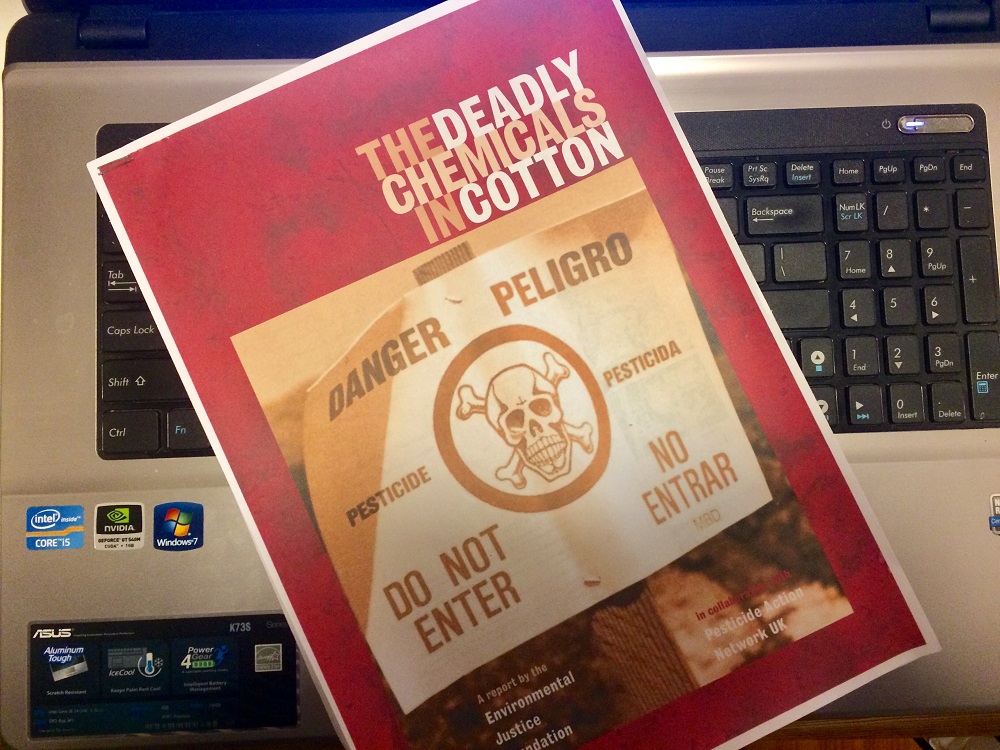
The answer is simple: no. There are at least 10 hazardous pesticides present in conventional cotton. Some, being so toxic, that even one drop of the substance when you placed it on your skin could kill you. Moreover, the students from the Technical University in Łódz, (Poland), conducted studies that proved the existence of the pesticides applied to a crop, in clothes made of it. How much pesticides athe farms use each year on cotton creation? World-wide, it is over US$ 2 billion of chemical pesticides. Further, US$ 819 million of it are highly hazardous according to the WHO (World Health Organisation).
Is conventional cotton toxic? What does “conventional cotton” mean?
When farmers grow cotton, and add harmful pesticides during the plants growth or production, we call this cotton “conventional”. This is what the big companies selling clothes see as “100% cotton”. The chemicals include fertilizers, insecticides, herbicides, defoliants. “Conventional” cotton uses 16% of globally sprayed insecticides. It is alarming to know, that most of the crops produced world-wide are “conventional”. The answer to a question whether it is toxic or not, is again straightforward: yes.
Do pesticides stay in cotton?
In 2004, researchers at the Technical University of Łódz in Poland found the answer. The pesticides, of which most are hazardous to human health and ecosystem, are present in the fabric. Moreover, the chemicals are in the crops after harvest. Using a home washing machine will not wash the chemicals out.
Is there a way to clean regular fabrics to remove all the toxic residues?
No. Let’s see how the farmers grow cotton and apply the pesticides:
What happens with cotton during each of the stages of its production? From harvest to a pair of jeans, there are multiple types of chemicals the farmers apply to the fabric.
- When it grows, they treat it with pesticides, weed killers and defoliants. According to Environmental Justice Foundation, almost 1 kilogram of pesticides is in use for every hectare under cotton. Moreover, they also grow the crop from GMO seeds. These are the seeds that are genetically changed.
- During its harvest, it already contains chemical substances, and they add additional ones. The farmers process cotton into yarns, weave , wash, brighten and bleach it. Also treat it with more chemicals for for texture. Some substances they use may contain dioxins. According to WHO (World Health Organization), dioxins are “environmental pollutants. They belong to the so-called “dirty dozen” – a group of dangerous chemicals known as persistent organic pollutants (POPs). Dioxins are of concern because of their highly toxic potential. Experiments have shown they affect a number of organs and systems”.
- At this stage, adding chemicals to the fabric is far from over. Now is the time to dye and print it. It achieves a color. Additionally, the fabric receives chemicals for softness and wrinkle resistance (such fabrics contain chemical formaldehyde). The result: The dyes often have plasticizers and heavy metals.
The dark side of western world cotton opulence
In the west, The USA, Canada, Europe, which are known as developed countries, regions, regular cotton became our most popular non-food agricultural commodity. For the season 2021/22 world conventional cotton production is forectast at 119,4 million bales. In 2004, the harvest totalled over 100 million bales. Within 16 years, the number of bales grew from a 100 to 119,4 million bales. It is nearly 20% growth. More land, more chemicals, more infected people and animals. Most of it goes to clothing production (60%), and 35% is used for home furnishings.
Created in the developing world, where people rarely have access to information about the side effects of pesticides. It is sold in North America (25% of global cotton production) and Europe (20% of cotton production) where buyers rarely think about where the cotton products come from and what they contain. Imagine if each piece of clothing had a label, on which the producers wrote the names of the chemicals used during its creation, and how they affected the farmers who harvested it. Would we be so discespectful, and got rid of things so easily, if we knew that the farmers in India, Pakistan, China or Uzbekistan were severely poisoned while growing cotton?
Organic cotton and conventional cotton (100% cotton) facts and figures
I was going to add more facts and figures here, to describe “conventional cotton” in more details. But, what I will do instead, is to describe how it affects people and the environment. Just imagine this. In India, which has one third of all cotton farmers, cotton production uses 54% of all pesticides for all the crops (of which cotton is just one of many). Moreover, it covers only 5% of land under all crops. One of the chemical substances there in use on cotton is monocrotophos. It is withdrawn from the USA, but still in use in India. They spend over 3 500 tonnes of it annually.
But… in 1997, the researchers saw that monocrotophos impacted children’s health. Paraguay’s Ministry of Health and Welfare discovered, that the substance caused paralysis in children. It is widely known, that respiratory failure can lead do death. The pesticide brings also muscular weakness, profuse perspiration, pain, vomiting, blurred vision, confusion. It is also very very toxic to natural world, especially to birds. Moreover other mammlas and bees.
Organic cotton
Grows without the use of hazardous substances. Protects the land, water, natural habitats. The farmers work with cotton and stay healthy. Finished fabrics are free from pesticides, insecticides, and can truly help you rejuvenate. Organic fabrics, GOTS certified are our path to the future. Chemical substances used for the “conventional cotton” production contaminate water, land for years. Read more about it on our page Organic cotton GOTS certified.
When did we start using pesticides
Humans started using chemical pesticides in the 1930s in the USA. But it was not until the time after World War II, that these chemical substances became widespread. The reason was that they increased farm yield. Nowadays pesticides help control insects in the crops. But the cost of it is tragically high, as it affects and destroys natural life. And… nature, healthy environment is our future.
Natural farming
The first farmers who started cotton cultivation lived 5000 years ago in the Indus Valley and South America. They did not use any agrochemicals, but followed tillage practices and agricultural management. The farmers lived and worked with the cycles of nature. They knew the pest cycles, and took them into consideration before planting seeds, and later at harvesting. What is interesting, is they planted cotton at lower densities, which helped them create distance between pest populations. The farmers implemented crop rotations as well.
And then… in the 50s of the XX century all was different. Chemical substances like DDT were used, to help with pest control.
Is it worth buying organic cotton
The answer is straightfoward: yes. In “conventional cotton” production, many chemical substances are used. Several stay in it even after the last stages of the fabric creation. Some of those substances are highly hazardous, like aldicarb,parathion, methamidophos, alpha-cypermethrin, dimethoate, deltamethrin, chlorpyrifos. You can also find dioxins in it. These substances affect natural habitats, human health, aquatic systems. They also stay in water or land for decades.
At the same time, organic cotton has none of these consequences. Its cultivation is spreading around the world. In a paper published by Environmental Justice Foundation in 2003, its authors stated, that the production of 100% organic cotton increassed 5-fold over the previous 4 years.
How can you tell if cotton is organic
First of all, organic fabrics look differently. And they have no chemical smell. When I see our organic fabrics, our GOTS certified organic cotton and satin (which is cotton too), I simply feel, that it is 100% organic. Often, if you are unsure, check whether the fabrics, clothes, bedding have any GOTS labels. GOTS certificate means: Global Organic Textile Standard. To read more about it, click here : GOTS certificate.
There are also other certificates, like Organic Content Standard (OCS). It is not as “clean” as GOTS, as OCS certificate simply states: ‘made with X% organically grown cotton’, so it does not need to be 100% organic. If you are unsure, ask the creators of the fabrics you are going to buy, or look for the certificates. Our fabrics are organic, and the cottons we use have GOTS certificates.
Organic mattresses and pillows
Just look how beautiful organic products are. Our company specializes in creating organic mattresses, made of organic fabrics and filled with organic, coming from nature hulls. Our customers love the products and have been using them for years. Read more about them, and how they help your body by discovering the article
Organic buckwheat hulls mattress
by EcoHealthLab, with organic GOTS certified cotton, and organic buckwheat hulls:




Leave a Reply