

Cotton pesticides in a conventional crop
WE buy beautiful clothes made of conventional cotton. Often they are full of colours, textures. What we focus on, mostly is a size of a particular item. However, lacking in knowledge about what cotton really contains, we choose clothes and fabrics without thinking of the risks we face. Further, conventional cotton harms us and the environment, as it contains toxic chemicals. Cotton pesticides the farmers and big companies use during cotton production cost globally US$2 billion a year. Moreover, of this sum, over US$ 819 million go to chemicals classified by WHO as hazardous.
Conventional cotton vs organic cotton
Globally, nearly 1 kilogram of pesticides is used per 1 hectare of land under cotton. And, it is a lot. Just imagine this: One of the most hazardous, if not the most dangerous of all, is aldicarb. This cotton chemical is so toxic, that if one drop was absorbed through the skin, it would kill an adult. Yet, global sales of this specific reach US$ 112 million a year…
Natural cotton is free from chemicals. Moreover, during each of the stages of the crop development to production no pesticides are used, only natural organic practices. It is natural and free from agrichemicals. However, people often choose the conventional path. In such situations, it pays to know, what the product has inside or where it comes from. Each of the cotton producing countries has a specific set of chemicals they use.
Cotton pesticides globally
In 2005, 33 countries took part in a survey about the use of pesticides. Further, these countries produce over 90% of global cotton (conventional cotton). Each of the participants gave a list of the specific chemical substances their farmers use. All of them had the hazardous pesticides on their lists. Among these countries were 18 (Brazil, Argentina, Egypt, Ethiopia, Greece, Cote d’Ivore, India, Iran, Mexico, Madagaskar, Peru, Pakistan, Philippines, Sudan, Turkey, Thailand, Zambia, Zimbabwe) with “Highly Hazardous” or “Extremely Hazardous” substances on their lists.
Now, imagine the hazardous chemicals being close to a skin of a child. It is not a pleasant image. However, in fact it is happening often. The fabrics contain in them the traces of the pesticides, moreover, children are used to spray the chemicals and to harvest cotton.

The impact on human health and nature
Compare the amount of the toxic substances used world-wide, their impact on insects and human health with the global love for conventional cotton. We wrote about it in our articles:
Conventional Cotton has a dark side and 100% cotton : a big lie
Among the pesticides used, almost 60% are the insecticides (data from 2007, Environmental Justice Foundation). Moreover, these agrichemicals impact biological processes, like the reproductive and nervous systems of all animals, including humans. Further, the farmers spend USD$ 1 310 million on insecticides a year (cotton only).
The lists of cotton pesticides by country
So, among the major cotton producers are: China, India, The USA, Brasil, Pakistan, Uzbekistan, Turkey, Australia, Benin, Greece. Essentially, the data gathered up to 2007, reveal what we may expect in the clothes coming from that areas. Moreover, the chemicals farmers use to grow cotton stay in the fabrics, it was proven by the studies conducted by the universities. By buying a piece of clothing, bedding of conventional cotton, you are buying its history as well. Let’s see, what do the farmers in particular countries use:
Cotton and pesticides in India
A country with 10 million cotton farmers. And, it is the biggest cotton farming community from all the countries cultivating the crop. Over 8,3 million hectares of land are there under cotton. However, they deliver only 13% of global cotton production. At the same time, the chemicals they use, cost US$ 344 million a year. The majority of the agrichemicals the Indian farmers apply are among the hazardous:
- Organophosphorus compund, monocrotophos (“Highly hazardous”)
- Endosulfan (“Hazardous”)
- Quinalphos (“Hazardous”)
- Fenvalerate (“Hazardous”)
- Chlorpyrifon (“Hazardous”)
Moreover, surveys reveal that in specific regions like Andhra Pradesh, the farmers use even more dangerous agrichemicals, known as “Extremely hazardous”:
- Parathion
- Methyl parathion
- Phosphamidon
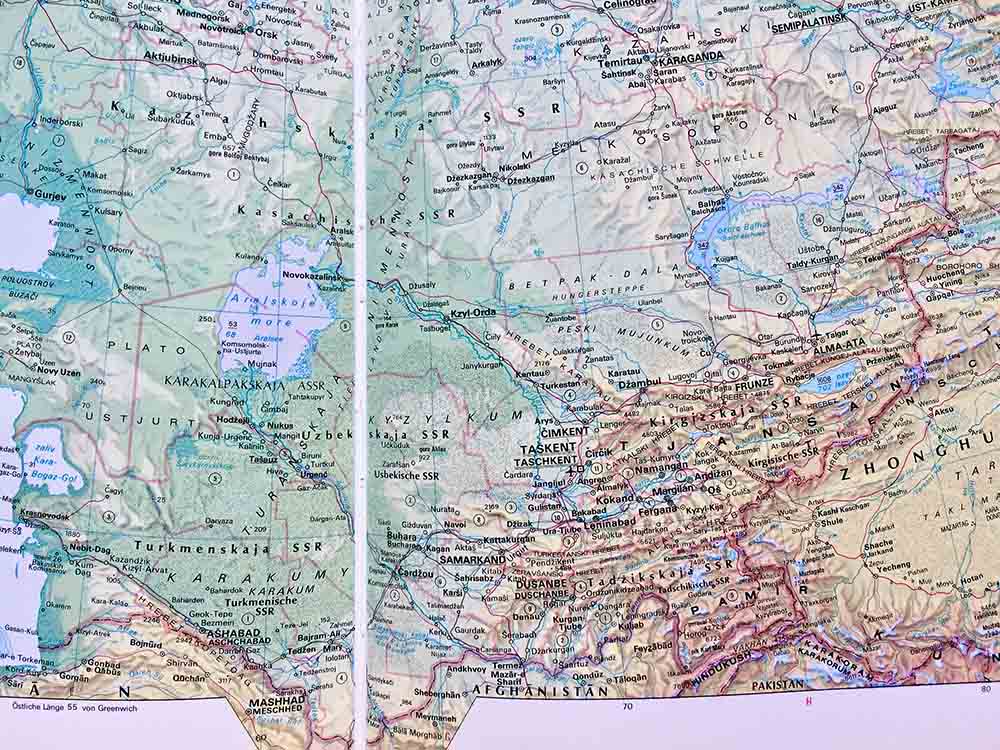
Chemicals in Uzbekistan
Among all the countries who produce cotton, Uzbekistan has a special place, and not for a good reason. When a country becomes a major cotton producer, you may expect pollution as a consequence. China, India, the US, Pakistan and other areas know this problem. However Uzbekistan experiences extreme contamination of its own land. Further, the country is the most severly affected by pesticides.
Its history of conventional cotton production began in the Soviet Era in the 50ties of the XX century. The extremely toxic chemicals from that time still contaminate the air, water and land, affect human health and the environment. Moreover, the substances from the Soviet era are still in use today. Finally, the state controls the companies who apply the chemicals.
Contamination on a large scale
In the past, they used DDT, aldrin, lindane, dieldrin, herbicides and defoliants. As we stated in our previous articles, nowadays nearly one kilogram of pesticides is spent globally on 1 hectare of land under cotton. However, not in Uzbekistan. Imagine this: In the past (starting from the 50-ties of the XX century), they used from 20 kg to 90 kg per hectare! It resulted in a tragic contamination of up to 90% of the land. Nowadays, the situation is better, but still highly dangerous. The researchers from the Environmental Justice Foundation wrote in 2007, that at least 10 of the pesticides from the Soviet Era are still in use today. They include
- Butifos
- Phosalone
They affect the central nervous system, liver, kidneys, heart and female fertility. (Further, the traces of the pesticides are felt throughout Central Asia, as the dust clouds travel and pollute the distant areas of the regions). Furthermore, the country itself is so contaminated, that groundwater tested at a depth of 100-150 m contains the chemicals. Finally, a 2000 study from a Karakalpakstan region exposed traces of DDT and lindane in water analysed.
“Silenced data”
In a recent article on Forbes, the researcher and journalist Brooke Roberts-Islam wrote about the difficulty of obtaining real data on cotton. Next, there are companies who have the information, but it is nearly impossible to reach the reports. In additiona, this shows, how lucrative the conventional cotton industry is. What’s more, it hides its dark sides. Only nearly 1% of all the cotton, is organic natural cotton. The remaining 99% is conventional cotton with the toxic chemicals.
Eventually, us, as the users of cotton, and global inhabitants of plant Earth, we should have access to knowledge and think what we are buying and wearing. It is also key to know, how does the fabric affect biodiversity.
The organisations telling the truth
Our knowledge comes from the reports of the Environmental Justice Foundation in the UK, Forbes, and European Parliament. If our plan is to be healthy in the future, we need to do something with the problem of the toxic chemicals in cotton.
The shocking disproportion
Now, when we have the data, and when we realize, that what we shared here in the article is a tip of an iceberg, the differences of our world look shocking. On one side we have tremendously conscious people, who know what products to choose, to live longer, have good health, grow healthy children. And on the other side, there are people who plant and grow conventional cotton, with their bare hands, and consequently suffer poisoning and even death. Our world needs healing. However, what I believe is that the best place to start, is with yourself.
Moreover, love and care you give yourself, your family and friends, is a great influence over your own future and the circle of the close ones in your life. Additionally, making more decisions about choosing the organic products, like our natural beds, will change your life, and those around you. Imagine, if most of us did that… our world would be much closer to heaven for us and the natural world. Choose life, choose organic products now.



Leave a Reply